
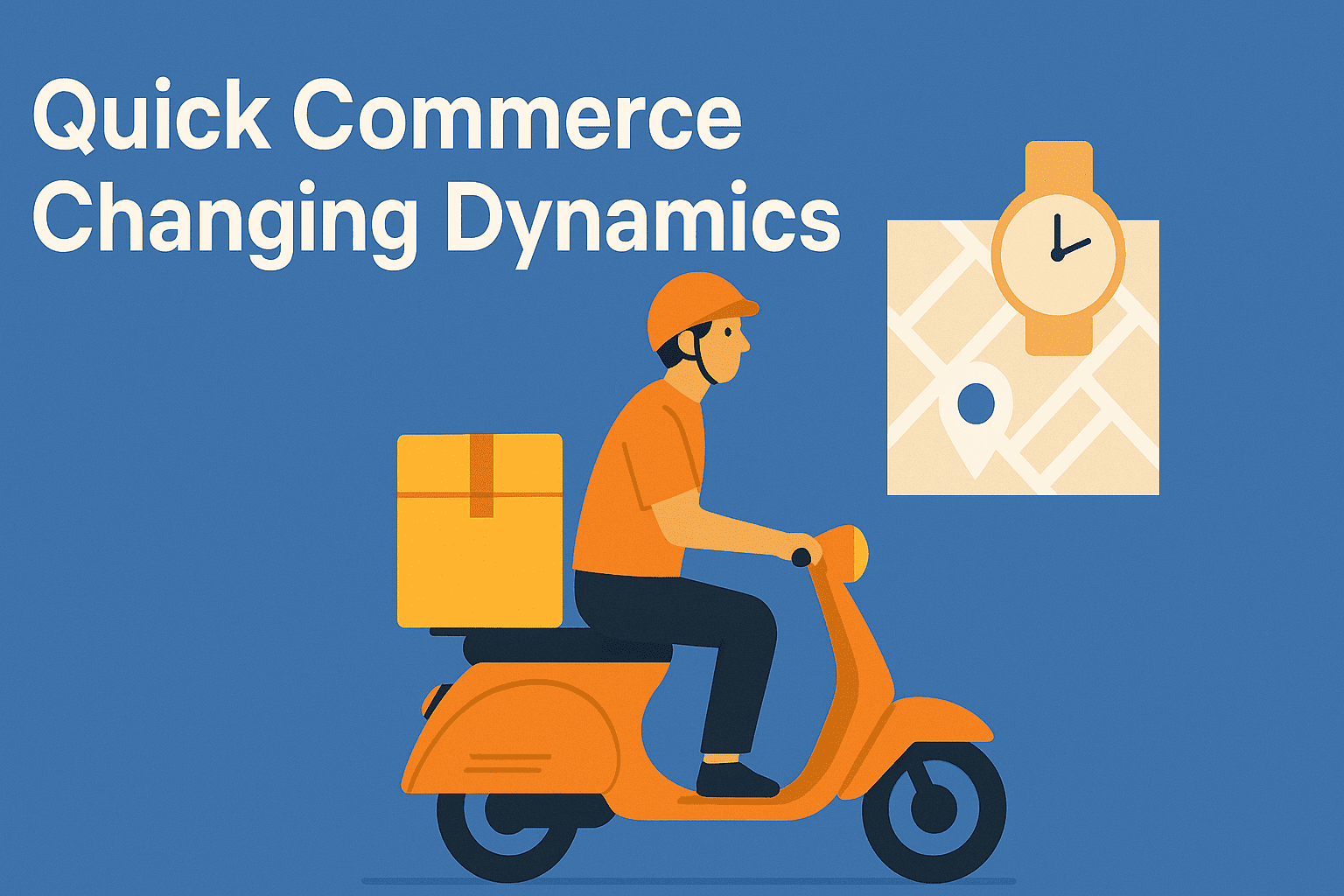
In a world that thrives on speed, Q-commerce has emerged as the next big thing in the retail landscape. Combining technology, logistics, and consumer behavior shifts, quick commerce is transforming how people shop for everyday essentials.
1. What is Q-commerce?
Q-commerce, short for quick commerce, is a modern evolution of e-commerce focused on ultra-fast delivery—often within 10 to 60 minutes. It primarily serves urban customers with a need for speed, delivering groceries, personal care items, OTC medicines, snacks, and other essentials almost instantly.
Unlike traditional e-commerce, which might take days to fulfill an order, Q-commerce operates with local fulfillment centers (micro-warehouses or dark stores) located close to customers. This decentralization of inventory and the use of fast last-mile delivery mechanisms (bikes, scooters, walkers) define Q-commerce’s unique value proposition.
2. Quick Commerce Changing Dynamics
The retail world is rapidly shifting. Consumers no longer want to wait for next-day deliveries when their needs are immediate. Several forces are driving the change:
-
Urban population density is increasing.
-
Consumer lifestyles are becoming more dynamic, spontaneous, and convenience-driven.
-
Pandemic disruptions accelerated expectations for contactless and rapid delivery.
-
Tech-savvy generations are more comfortable with app-based shopping experiences.
These dynamics are reshaping the competitive landscape, giving rise to new players and forcing traditional retailers to rethink their logistics and digital strategies.
3. Quick Commerce Characteristics
3.1. 1. Speed of Delivery
The hallmark of Q-commerce is speed. Deliveries are typically fulfilled within 10 to 60 minutes from the time an order is placed. This is made possible through local warehouses and streamlined logistics, bypassing traditional distribution networks.
3.2. 2. Limited Product Range
Q-commerce platforms focus on fast-moving consumer goods (FMCGs) and high-urgency items. Instead of offering tens of thousands of SKUs, they provide a curated catalog of 1,000 to 5,000 essential products based on location-specific demand.
3.3. 3. Technological Integration
Technology powers the Q-commerce model. Key elements include:
-
Real-time inventory management
-
AI-based demand forecasting
-
Route optimization for last-mile delivery
-
Intuitive mobile apps with a frictionless checkout process
3.4. 4. Small Order Sizes
Unlike traditional e-commerce, where users might buy in bulk, Q-commerce thrives on smaller baskets—often 1–5 items per order. This behavior reflects the impulse-driven and necessity-based nature of the model.
3.5. 5. Localized Operations
To meet rapid delivery times, Q-commerce relies on highly localized logistics. Urban fulfillment centers, or “dark stores,” are strategically positioned close to high-demand neighborhoods. These centers operate exclusively for online orders, with no walk-in customers.
3.6. 6. Cost Structure
Q-commerce optimizes costs differently than traditional e-commerce:
-
Lower storage costs due to limited inventory and smaller facilities
-
High delivery frequency, which improves per-order efficiency
-
Reduced packaging costs, thanks to lighter and smaller orders
However, balancing profitability remains a challenge due to tight margins and competitive pressure to offer free delivery.
4. How Q-commerce Differs From E-Commerce
4.1. 1. Speed of Delivery
-
E-commerce: 1–5 days (sometimes same-day options)
-
Q-commerce: 10–60 minutes from order placement
4.2. Product Range
-
E-commerce: Extensive catalog covering thousands of categories
-
Q-commerce: Essentials and high-frequency items only
4.3. Operational Model
-
E-commerce: Centralized warehouses and regional logistics
-
Q-commerce: Hyper-local fulfillment via dark stores or micro hubs
4.4. Technological Integration
-
E-commerce: Integrates logistics, recommendation engines, and CRM
-
Q-commerce: Leverages real-time order routing, mobile-first UX, and agile delivery networks
5. Conclusion
Quick commerce is more than a trend—it’s a reshaping of retail expectations. As lifestyles become faster and more urbanized, the demand for instant fulfillment will only grow. Businesses that adapt early to the Q-commerce model can gain a competitive edge by offering consumers what they value most: speed, convenience, and simplicity.
Whether you’re a startup looking to break into this space or an established retailer aiming to pivot, now is the time to rethink how your products reach your customers—and how fast.